

Plastic beverage bottles are so common that it is easy to stop noticing what they are made from. Yet the material inside a bottle affects its strength, clarity, weight, safety, shelf life, and recyclability. Most beverage bottles used for water, soft drinks, juices, and other beverages are made from carefully selected plastic polymers that can be shaped into thin, strong containers. 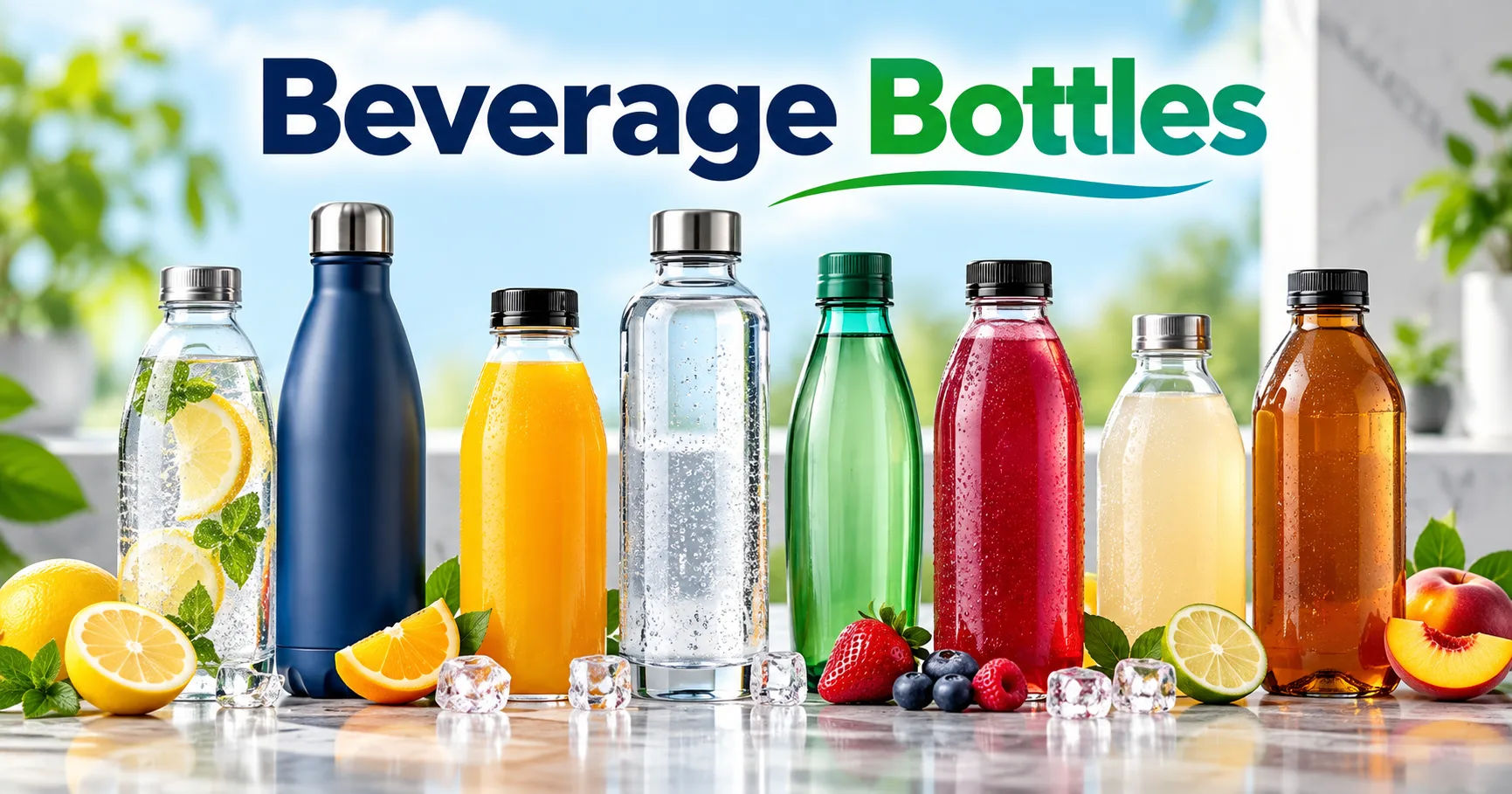 The main material used for many single-use bottles is polyethylene terephthalate, usually called PET or PETE. It is popular because it is lightweight, transparent, tough, and suitable for contact with many drinks. Other plastics, including high-density polyethylene and polypropylene, are used for particular beverage packaging needs.
Understanding what goes into beverage bottles also explains why some containers feel rigid while others are flexible, why some are crystal clear, and why recycling symbols differ. The plastic is not simply melted into a beverage bottle without planning. Manufacturers choose a resin, add approved ingredients when needed, process it under controlled conditions, and design the container around the beverage and distribution environment.
The Main Plastic Used in Bottles
Polyethylene Terephthalate
PET is the dominant plastic for many carbonated drinks and bottled water. It belongs to a family of materials known as polyesters. PET is produced from chemical building blocks that are reacted to create long polymer chains.
In simple terms, these chains give the material its useful combination of strength and flexibility. A beverage bottle made from PET can be very thin while still resisting ordinary handling and pressure.
PET is also naturally clear when processed correctly. That transparency is useful because consumers can see the product, while manufacturers can create shapes that look clean and consistent.
Why PET Is So Common
There are several practical reasons PET is widely used for beverage packaging. It has good mechanical strength, relatively low weight, and useful barrier properties. It can also be processed efficiently on high-speed manufacturing equipment.
For carbonated beverages, strength matters because dissolved carbon dioxide creates internal pressure. The bottle needs to retain its shape during filling, storage, transportation, and use.
PET can also be manufactured in different grades. The exact formulation and processing conditions can be adjusted for the intended application.
Other Plastics Used for Beverage Packaging
PET is not the only plastic found in beverage containers.
High-Density Polyethylene
High-density polyethylene, or HDPE, is another common packaging plastic. It is usually opaque or naturally translucent rather than crystal clear. HDPE has good toughness and chemical resistance.
It is often used for products where rigidity and durability are important. Milk containers are a familiar example, although packaging choices vary by market and product.
Polypropylene
Polypropylene, commonly abbreviated PP, can appear in beverage packaging components such as caps, closures, and specialized containers. It has a relatively high melting point and good resistance to many chemicals.
The plastic used for the bottle itself may therefore be different from the plastic used for its cap. Packaging is often a combination of materials selected for different jobs.
Low-Density Polyethylene
Low-density polyethylene, or LDPE, is softer and more flexible than PET or HDPE. It is less common as the main material for conventional rigid drink bottles, but it can be useful in flexible packaging and certain components.
The choice depends on the required flexibility, seal performance, toughness, and processing method.
What Are PET Bottles Made From Chemically?
PET is created through a chemical process involving two primary raw-material components: ethylene glycol and terephthalic acid, or closely related feedstocks depending on the manufacturing route.
These substances react to form PET polymer. The resulting material consists of long chains of repeating chemical units.
The polymer is then produced as a resin, commonly in the form of small pellets or chips. These pellets are the starting material for many bottle manufacturing operations.
It is important to distinguish the polymer from the finished bottle. A bottle is not simply a chunk of raw resin. The resin is dried, melted, formed, stretched, and cooled in a controlled sequence.
How Plastic Becomes a Bottle
Resin Preparation
Before processing, PET resin must be handled carefully. Moisture can interfere with PET during high-temperature processing and can reduce the quality of the finished material.
For this reason, manufacturers typically dry the resin before melting it. The exact drying conditions depend on the resin and production system.
Making the Preform
Many PET bottles begin as something called a preform. A preform looks somewhat like a small, thick-walled test tube with a finished neck and threaded opening.
The resin is melted and injection molded into this shape. At this stage, the plastic is much thicker than the final bottle.
The preform is then transferred to equipment where it is reheated and stretched into the final container.
Stretch Blow Molding
During stretch blow molding, the preform is heated to a suitable temperature and mechanically stretched. Air is then used to expand the material against a bottle-shaped mold.
This process is important because stretching can improve the material's strength and allow manufacturers to make lightweight containers.
The final wall thickness is carefully controlled. A beverage bottle does not need the same thickness everywhere. The base, shoulder, body, and neck may have different structural requirements.
Why Bottles Are So Lightweight
Modern packaging engineers have spent decades reducing the amount of plastic needed to make functional containers.
A lightweight bottle uses less resin, which can reduce material consumption and transportation weight. However, reducing material too far can create problems.
A bottle still needs enough strength to survive filling, capping, stacking, transportation, retail handling, and consumer use.
This creates a design balance. The goal is not simply to make the thinnest possible container. It is to make a container that performs its job with an appropriate amount of material.
What Makes a Plastic Bottle Clear?
PET can be highly transparent because of the way its molecular structure behaves during processing.
Manufacturers control cooling, stretching, and other conditions to influence crystallinity. Excessive crystallization can make PET appear cloudy or opaque.
Clear beverage bottles are particularly useful for water and soft drinks because appearance is part of the packaging experience.
Color can also be added when a manufacturer wants the container to have a particular appearance or provide additional protection for the contents.
Additives and Other Ingredients
The basic polymer is the major component, but some plastic packaging can contain small amounts of other substances used to support processing or provide specific properties.
These can include colorants, stabilizers, processing aids, and other substances permitted for the intended packaging application.
The exact composition depends on the polymer, manufacturer, product, regulations, and performance requirements.
Food-contact packaging is subject to safety requirements. Materials intended for beverages must be manufactured and tested according to applicable regulations and specifications.
Are Plastic Bottles Safe for Drinks?
When a bottle is properly manufactured and intended for its particular beverage, the packaging is designed to meet applicable food-contact requirements.
Safety is not determined by the word “plastic” alone. Different polymers have different properties, and the formulation, manufacturing process, storage conditions, and intended use all matter.
A bottle designed for a cold drink should not automatically be treated as suitable for every possible use. Heat, chemicals, sunlight, and repeated reuse can affect materials differently.
Consumers should follow the manufacturer's intended-use guidance, particularly when a container is designed as a single-use package.
Why Carbonated Drinks Need Strong Bottles
Carbonated drinks present a special engineering challenge. Carbon dioxide dissolved in the liquid creates pressure inside the container.
The beverage bottle therefore needs sufficient strength to resist expansion and maintain its shape.
PET is well suited to this application because its strength-to-weight characteristics allow manufacturers to create relatively light containers that can handle internal pressure.
Bottle shape matters too. Ribs, curves, the base design, and wall distribution can all influence performance.
What About the Bottle Cap?
The cap is often made from a different plastic than the beverage bottle.
PP and HDPE are commonly used for closures because they offer useful combinations of toughness, stiffness, chemical resistance, and processability.
The cap also needs to form a reliable seal. Its threads must engage properly with the bottle neck, while the sealing area needs to prevent leakage under normal handling.
Modern closure systems can also be designed to remain attached to the bottle after opening, depending on regional requirements and packaging design.
What Is the Recycling Number?
PET beverage bottles commonly carry the recycling identification code associated with PET. The familiar number 1 inside the recycling triangle is widely used to identify PET.
The symbol identifies the type of plastic resin. It does not, by itself, guarantee that a particular local recycling program accepts the item.
Recycling availability varies by country, municipality, collection system, and facility. A PET bottle may be technically recyclable while still not being collected in a particular area.
What Happens to Recycled PET?
Used PET from beverage bottles can be collected, sorted, cleaned, processed, and converted into recycled PET, often abbreviated rPET.
The material may be mechanically recycled into flakes and then further processed into usable resin or other products.
For some applications, recycled PET can be used again in packaging when appropriate processing and regulatory requirements are met.
Recycling does not mean that every used bottle automatically becomes another bottle. Some recycled material may enter other applications, depending on quality, demand, collection systems, and economics.
Why Bottle Design Matters
The material alone does not determine how well a container performs. Bottle geometry is equally important.
Engineers consider grip, pressure resistance, top-load strength, drop performance, stability, filling speed, labeling, and transportation.
A tall beverage bottle may need different structural features from a short, wide bottle. A carbonated drink may require different engineering from still water.
This is why two beverage bottles made from the same PET resin can behave quite differently.
How Temperature Affects Plastic Bottles
Temperature can influence plastic performance. Very high temperatures may soften or deform some containers, while very low temperatures can affect impact behavior.
For everyday beverage packaging, manufacturers design containers around expected storage and distribution conditions.
Consumers should also avoid assuming that any plastic beverage bottle is suitable for high-temperature applications simply because it holds a drink safely at room temperature.
PET Compared With Glass and Aluminum
Plastic is only one option for beverage packaging. Glass is rigid, chemically stable, and highly reusable in suitable systems, but it is heavy and breakable.
Aluminum cans are lightweight and provide excellent protection from light. They are especially common for carbonated drinks.
PET offers a different combination: low weight, toughness, transparency, and efficient manufacturing.
There is no single material that is ideal for every beverage. Packaging decisions involve product protection, cost, transportation, shelf life, manufacturing requirements, consumer convenience, and end-of-life systems.
Environmental Considerations
The environmental impact of a bottle involves more than the plastic itself.
Manufacturers consider the amount of resin used, energy consumed during production, transportation weight, recycling rates, and what happens after disposal.
Lightweighting can reduce material use, but recycling systems also matter. A beverage bottle that is collected and properly processed has a different end-of-life pathway from one that is discarded.
Using recycled resin can also reduce dependence on newly produced plastic when suitable recycled material is available.
At the same time, recycled content has to meet technical and regulatory requirements for its intended use.
Can Plastic Bottles Be Made From Recycled Material?
Yes. Recycled PET is already used in various packaging applications.
The basic process involves collecting used PET, sorting it, removing contaminants, washing it, and processing it into a form suitable for further manufacturing.
For food-contact applications, additional controls are necessary because the recycled material must meet relevant safety and quality standards.
The proportion of recycled material can vary. Some beverage bottles may contain a mixture of new and recycled PET, while packaging specifications differ by manufacturer and market.
How Manufacturers Choose the Right Plastic
The choice begins with the beverage and its requirements.
Water, carbonated soft drinks, juices, dairy beverages, and other products can have different packaging needs. Factors such as acidity, carbonation, oxygen sensitivity, light sensitivity, temperature, shelf life, and distribution conditions can influence the decision.
Manufacturers also consider production speed, bottle shape, closure compatibility, labeling, transportation, and recycling goals.
In other words, selecting plastic is an engineering decision rather than a simple preference.
When choosing materials, manufacturers also consider how beverage bottles will be filled, capped, labeled, stored, and transported.
The neck finish of beverage bottles must match the closure so the package can seal consistently.
For lightweight beverage bottles, careful engineering is needed to prevent excessive deformation during handling.
The appearance of beverage bottles can also influence how consumers perceive freshness and quality.
Recycled PET can give beverage bottles a way to incorporate material recovered from previous packaging.
The production of beverage bottles involves precise temperatures because polymer behavior changes during heating and cooling.
In factories, beverage bottles are inspected for defects such as cracks, weak areas, poor molding, or inconsistent dimensions.
The shape of beverage bottles can be optimized to improve stacking and reduce wasted space during transportation.
Some beverage bottles are designed with textured surfaces to make gripping easier, especially when condensation forms on the outside.
For carbonated products, beverage bottles must be designed around pressure, temperature, and expected storage conditions.
Labels and sleeves used on beverage bottles can also affect sorting and recycling processes if they are not compatible with recycling systems.
The growing use of recycled resin means beverage bottles may increasingly include material from previously used packaging.
Ultimately, the performance of beverage bottles comes from the combination of polymer chemistry, bottle geometry, manufacturing controls, and proper use.
Conclusion
Plastic beverage bottles are mainly made from polymers selected for strength, weight, chemical resistance, transparency, and processing performance. PET is the most familiar material for many bottled waters and carbonated drinks, while HDPE, PP, and other plastics have roles in specific containers and packaging components.
A finished bottle has gone through much more than a simple molding step. PET resin is prepared, formed into a preform, reheated, stretched, and blown into the final shape. Its thickness, geometry, closure, and processing conditions are carefully controlled so the container can protect the drink while using a practical amount of material.
The plastic used in beverage bottles also affects recycling. PET can be collected and processed into recycled PET, although actual recycling depends heavily on local collection and processing infrastructure. Understanding these materials makes it easier to see why packaging design involves a balance between safety, performance, cost, convenience, and environmental considerations.
Knowing what plastic bottles are made from is therefore not just a chemistry question. It is also a lesson in materials engineering and modern packaging. From the resin pellet to the finished beverage bottle on a store shelf, each stage is designed to give the container the properties needed for its particular beverage.